





SIX FULFILLED PROPHECIES OF CHRIST’S BIRTH
(Jesus Christ was Born in the Fullness of Time)
When the fullness of the time had come, God sent forth 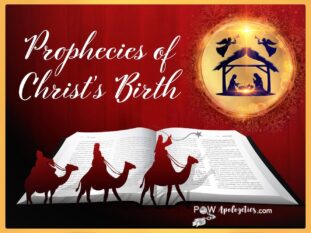
His Son, born of a woman, born under the law,
to redeem those who were under the law.
(Gal. 4:4–5 NKJV)
The day Jesus Christ was born has universe-rocking significance. At just the proper moment—“in the fullness of time”[1]—God sent forth His Son to redeem humanity. Jesus willingly stepped into time and space to take on human flesh and accomplish the greatest rescue mission the world has ever known. Love personified came down to earth!
To grasp some of the infinite greatness of our Savior, let’s telescope into the Bible’s Old Testament (OT) to view six major predictive prophecies surrounding the Messiah’s birth.[2] Then we’ll take a look at Jesus’s fulfillment of them centuries later in the New Testament (NT). This will clarify the identity of the long-awaited Messiah, and will likely stir our hearts with deep devotion for the King of all kings, who loves us and gave Himself for us.
 1. The Messiah would be born in Bethlehem.
In the sixth century BC, the prophet Micah foretold that the Messiah would be born in the small town of Bethlehem. “But you, Bethlehem Ephrathah, though you are little among the thousands of Judah, yet out of You shall come forth to Me the One to be ruler in Israel, whose goings forth have been from of old, from everlasting.”[3] By revealing the precise name of the humble town for His Son’s birth, God eliminated all other cities in the world as possibilities[4]—setting the stage for people to recognize the epic Christmas Day miracle.
NT Fulfillment: Under the inspiration of the Holy Spirit, Luke recorded that Jesus was born in Bethlehem, affirming His birthplace historically.[5] Matthew also told us, “After Jesus was born in Bethlehem of Judea in the days of Herod the king, behold, wise men from the East came to Jerusalem, saying, ‘Where is He who has been born king of the Jews?’”[6] Other fulfilled prophecies speak of the wise men (the magi) as camel riders who would bow down to the Messiah-King and present Him with praises and royal gifts of gold and frankincense.[7-8]
2. The Messiah would come from a highly specific lineage.
To fulfill the exact credentials of the Messiah, one single person would need to fulfill all of these lineage requirements: (1) be the offspring (seed) of a woman, (2) be born of a virgin, (3) be born of the seed of Abraham (come from the Hebrew race), (4) be the descendant of Isaac, (5) be the descendant of Jacob, (6) come from the tribe of Judah, (7) come from the family line of Jesse, (8) and come from the family line of David.[9] Consider also the miraculous nature of the first requirement. For biologically speaking, the seed (the Hebrew word for offspring) comes from the man, not the woman.[10]
NT Fulfillment: God surely guides history, for Jesus fulfilled all of those genealogical prophecies at His birth.[11] For example, when the apostle Paul wrote that the Son of God was “born of a woman,” he affirmed the Genesis 3:15 prophecy indicating the Messiah would be the offspring (seed) of the woman.[12] Also, both Matthew and Luke presented eyewitness testimony of Jesus’s virgin birth.[13] In one verse, Matthew said an angel told Joseph, “Do not be afraid to take to you Mary your wife, for that which is conceived in her is of the Holy Spirit.”[14]
3. The Messiah would have a forerunner proclaiming His arrival.
Isaiah prophesied (in Isaiah 40:3) about a personal forerunner who would precede the Messiah. He wrote, “The voice of one crying in the wilderness: Prepare the way of the Lord; make straight in the desert a highway for our God.”[15] As with many biblical prophecies, this passage has a dual fulfillment. The “near fulfillment” predicted the Jews’ deliverance from Babylon, whereas the “far fulfillment” (700 years later) referred to John the Baptist. When John showed up in the wilderness, he applied Isaiah’s prophecy to himself, saying, “I am the voice of one calling in the wilderness, ‘Make straight the way of the Lord.’”[16] In addition, the first verse of a prophetic passage written by Malachi similarly refers to the messenger John the Baptist, “Behold, I send My messenger, and he will prepare the way before Me.”[17-18]
NT Fulfillment: The Isaiah 40:3 prophecy was quoted in all four of the Gospels, affirming that John the Baptist came as the Messiah’s forerunner, and his voice was heard.[19] For example, Matthew 3:3 states that when John the Baptist came, he challenged the people to prepare for the coming Messiah as was foretold by Isaiah. Even John’s father, Zacharias, prophesied that his child (still in Elizabeth’s womb) would be called “the prophet of the Highest” and would “go before the face of the Lord to prepare His ways.”[20] And by God’s providence, Elizabeth comforted Mary when the angel Gabriel told Mary she would miraculously give birth to the Messiah. The two women spent three months together after Elizabeth’s own conception miracle—by giving birth to John the Baptist in her old age after years of barrenness—illustrating that “with God nothing will be impossible.”[21]
4. The Messiah would be the target of Herod’s death plan.
The prophetic picture presented in Jeremiah 31:15 has both a far and near fulfillment.[22] At the time it was written, it referred to the bitter weeping and mourning that took place when mothers were separated from their children at the time of the Babylonian captivity. Its future reference referred to Jewish mothers in the first century AD who wept bitterly at the murder of their infant sons by Herod.[23]
NT Fulfillment: Matthew wrote that Jeremiah’s prophecy was fulfilled when Jesus was an infant and King Herod ordered the death of all male children, two years old and under, who lived in the Bethlehem region.[24] By doing so, Herod attempted to destroy the newborn “King of the Jews.” However, God thwarted Herod’s plan. An angel of the Lord appeared to Joseph in a dream, saying, “Arise, take the young Child and His mother, flee to Egypt….”[25] Joseph and Mary then fled to Egypt with the baby Jesus for safety until the death of Herod. Matthew also pointed out that such divine rescue also fulfilled a prophecy (using biblical typology) spoken through the prophet Hosea, “Out of Egypt I called My Son.”[26]
5. The Messiah would be born of a virgin.
Isaiah 7:14 is one of the most famous prophecies about the Christmas story, pointing to Jesus’s incarnation.[27] This passage has a near and a far fulfillment. In the immediate context, the Lord gave a supernatural sign to Ahaz, king of Judah: “Behold, the virgin [almah in Hebrew, which can also mean “young woman”] shall conceive and bear a Son and shall call His name Immanuel.” God was illustrating His sovereign ability to know the future, that Judah would receive relief from attacks by Israel and Syria.[28] In the distant context, God’s sign meant that an actual virgin would miraculously conceive by the Holy Spirit’s power and give birth to His own Son.[29] Consider also the glorious Isaiah 9:6 prophecy, which begins, “For unto us a Child is born” referring to Jesus’s birth from the human side of the Christmas story (His humanity). It continues, “Unto us a Son is given” referring to Jesus’s birth from the divine side of the story (His deity).[30] The Messiah would be fully God and fully man.
NT Fulfillment: Three of the reasons we know Jesus was miraculously born of a virgin are: (1) The Lord’s supernatural sign to Ahaz was addressed not only to him but to the entire house of David[31] from which the Messiah would come. (2) In the Septuagint (the Greek translation of the Hebrew Scriptures in the first few centuries BC, before Jesus came), the Jews translated the word almah using the Greek word parthenos, which only means “virgin.”[32] (3) And the Gospels of Matthew and Luke present eyewitness testimony to this truth, including that of Mary herself.[33] Thankfully, Jesus Christ was born of the virgin Mary historically to save us from our sins. “If Jesus were not fully man, He could not stand in the place of sinful man and be a substitute for the punishment man deserves. If He were not fully God, His sacrifice would be insufficient.”[34]
6. The Messiah’s names would be Jesus and Immanuel.
The name Jesus was predetermined long before His birth. Jesus in Hebrew is Yeshua (short for Yehoshua, meaning “God is salvation”).[35] And Yeshua appears numerous times in the OT. So although the Messiah did not receive the name Jesus until His birth, “He still was Yehoshua because He has always been salvation from the beginning to the end.”[36] Looking again at the virgin birth prophecy in Isaiah 7:14, it also specified that the coming Messiah would be called Immanuel. Then in Isaiah’s next chapter, he also mentioned “God is with us” (Immanuel in Hebrew)—referring to the Immanuel prophecy.[37]
NT Fulfillment: Luke wrote that the angel Gabriel told Mary she was to name the Christ Child Jesus.[38] Similarly, Matthew recorded that an angel of the Lord told Joseph in a dream to call Him Jesus—and then added this reason: “For He will save His people from their sins.”[39] He then quoted the Isaiah 7:14 virgin prophecy, confirming that God fulfilled it when Mary gave birth to Jesus, and that He would be called Immanuel.[40] Jesus was not spoken to directly by that name, however His nature and earthly ministry make Him Immanuel.[41] Jesus is literally “God with us” by His incarnation—and He will always “be with us” (His believers).
Thus, the long-awaited Messiah—who loves us so deeply that He died on a Roman cross in 33 AD to deliver us from sin and its eternal consequences—is both Yeshua and Immanuel. According to the grand narrative of the Bible,[42] Love came down. God sent His divine Son to earth to be born on Christmas Day, to redeem us in the fullness of time.
“Thanks be to God for His indescribable gift [Jesus]!”[43]
 CONSIDER: Do these beams of prophetic illumination from Scripture remind you that Jesus Christ and eternal salvation are divine gifts, which the King freely offers to everyone? Have you chosen to open those gifts with gratitude and enjoy them now and forevermore, by simply praying to receive them?
PRAYER: Lord Jesus, thank You for leaving the glories of heaven to come to earth as an infant in obedience to the Father and out of love for us. The wonder of all wonders is that You loved us so much that You humbly became one of us. Then You rocked the universe by shedding Your precious blood on the cross to purchase our salvation. Hallelujah! Thank You, amen.
AN APOLOGETIC TAKEWAY: Based on these six prophecies surrounding Christ’s birth, together with Jesus’s accurate fulfillment of them, we can recognize that He is the long-predicted Messiah. And that He is God who came to earth in human flesh (John 1:1–2, 14). In addition, based on the 300 messianic prophecies in the ancient OT Hebrew Scriptures fulfilled by Jesus,[44] we can see that God is faithful to perform His promises. And since the overall theme of the Bible is God’s plan of redemption for humanity, we can acknowledge God’s sacrificial love for all people in that our Savior was born to die for us—”the Lamb slain from the foundation of the world” (Rev. 13:8).
______________
All Scripture quotations in this publication are from the New King James Version. Copyright 1982 by Thomas Nelson, Inc. Used by permission. All rights reserved.
[1]Gal. 4:4. [2]The OT contains over 300 messianic prophecies fulfilled by Jesus Christ (a convincing proof of the reliability of the Bible). [3]Num. 24:17, 19; Micah 5:2. [4]Josh McDowell, The New Evidence that Demands a Verdict (Thomas Nelson, 1999), p. 174. See also Josh and Sean McDowell’s Evidence expanded, 2017, Chap. 9. [5]Luke 2:4. [6]Matt. 2:1–2; see also John 7:42. [7-8]Psalm 72:8–11; Isaiah 60:3, 6 (fulfilled in Matt. 2:1, 11). [9]Gen. 3:15; 21:12; 22:18; 49:10; Num. 24:17; 2 Sam. 7:12–16; Isa. 7:14; 11:1, 10; Jer. 23:5; 1 Chron. 17:11–14. Josh McDowell, 168–173. [10]ICR’s Bible Study Tools (www.icr.org/bible/Genesis/3/15/). [11]Matt. 1:1–2, 6, 18, 24–25; Luke 1:26–35; 3:23–35; Gal. 3:16; 4:4; and Heb. 7:14. [12]Gal. 4:4. [13]Matt. 1:18, 24–25; and Luke 1:26–35. [14]Matt. 1:20. [15]Isaiah 40:3. [16]John 1:23. [17]Mal. 3:1(a). The next portion of this passage refers to the Messiah as the “Messenger of the covenant.” [18]Thru the Bible with J. Vernon McGee (Thomas Nelson) on Malachi 3. [19]Matt. 3:1; Mark 1:2–4; Luke 3:2–6; and John 1:23. [20]Luke 1:76. [21]Luke 1:37. See also vv. 36–56. [22]A (hermeneutical) principle of predictive prophecy. [23]Jon Courson’s Application Commentary (Thomas Nelson) on Jer. 31:10–15. [24]Matt. 2:6–18. [25]Matt. 2:13–15. [26]Hosea 11:1; Matt. 2:15. See the Got Questions commentary: www.gotquestions.org/Hosea-11-1-Messianic.html. [27]The Christian doctrine that God took on human form in the Person of Jesus Christ (e.g., John 1:1, 14). [28]David Guzik, The Enduring Word, online Bible Commentary, on Isaiah 7:14. [29]Luke 1:35. See McGee on Isaiah 7:14. [30]The BLB, Chuck Smith’s commentary on Isaiah 9:6. www.blueletterbible.org. [31]Isaiah 7:13. [32]“Thus, the Jews were convinced that this was a prophecy of a miracle that a virgin would give forth a son.” Dr. John Warwick Montgomery, online interview at Patrick Henry College, 12/19/2013. [33]Ibid. [34]Guzik on Isaiah 9:6. [35] https://www.compellingtruth.org/Yeshua-Jesus.html [36]The Blue Letter Bible, https://blogs.blueletterbible.org/blb/2012/01/31/yahweh-is-salvation/. [37]See Guzik on Isa. 8:10. [38]Luke 1:31. [39]Matt. 1:21. [40]Matt. 1:22–23. [41]Courson on Matthew 1:22–23. [42]Guzik on Genesis 3:15. Here God first mentioned His “plan of salvation through the one known as the Seed of the woman.” [43]2 Cor. 9:15. [44] McDowell’s Evidence expanded, 2017; see also: https://www.gotquestions.org/prophecies-of-Jesus.html.
Note: This blog post is an adaptation of an article written by Marilyn Joy Tyner, published in the 2021 Christmas devotional E-Book (a collaboration of 20 apologists/artists/poets). Women in Apologetics, Inc., Love Came Down: A 30-Day Devotional on the Birth of Christ, first E-book ed., WIA, Inc., Lebanon, TN, 2021.)