





PART 2 – CAN WE TOTALLY TRUST THE BIBLE?
Three Main Proofs—the Bible is True and Trustworthy
(Cont.) Manuscript Evidence
for the New Testament:
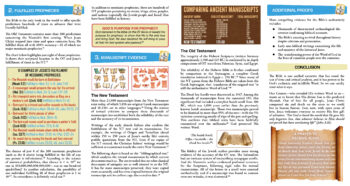
Writings of the early church fathers also confirm the faithfulness of the NT text and its transmission. For example, the writings of Origen and Tertullian (dated within 150 to 250 years of Jesus’s earthy life) contain prolific quotations from the New Testament (NT). Even if no copies of the NT existed, the Christian fathers’ writings would be sufficient to reconstruct nearly the entire New Testament.17
The “bibliographical test” analyzes the textual transmission by which ancient documents reach us. This test revealed that no other classical documents of antiquity are as well attested to as the NT. It has far more manuscripts preserved, they were copied more accurately, and less time elapsed between the original manuscript and its earliest copy discovered to date.18
The earliest NT manuscript copy is dated 125 AD, and 5,856 NT manuscript copies have been preserved. The ancient work in second place is Homer’s Iliad. Its earliest manuscript copy is dated 415 BC, and 1,900 manuscript copies have been preserved (see fn 2, McDowell, 52-56).
 The Old Testament:
The integrity of the Hebrew Scriptures (written between approximately 1,500 and 425 BC) is confirmed by in-depth comparisons of OT texts from Palestine, Syria, and Egypt.
The reliability of the Hebrew Bible is further confirmed by comparison to the Septuagint, a complete Greek translation initiated in Egypt c. 250 BC.19 Since many of the NT quotes from the Hebrew Bible are taken from the Greek Septuagint, that translation of the original text “is still the authoritative Word of God.”20
The Dead Sea Scrolls were discovered in 1947. Among the thousands of manuscripts from the canonical OT, this significant find included a complete Isaiah scroll from 100 BC, which was 1,000 years earlier than the previously known Isaiah manuscript. Those two manuscripts proved to be identical in more than 95% of the text—with the 5% variation consisting mostly of slips of the pen and spelling. This confirms that biblical texts have been faithfully transmitted over the millennia.21 God preserved His written Word.
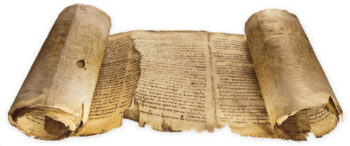 (The Isaiah Scroll, 1Qlsa – Facsimile
– the Dead Sea Scrolls22)
The fidelity of the Jewish scribes provides more strong evidence of the accuracy of the OT text. The Talmudists had an intricate system of transcribing synagogue scrolls. And the Masoretic scribes evidenced profound reverence for the Scriptures, following rigid rules for textual transmission. All of the letters in a scroll were counted methodically, and if a manuscript was found to contain even one mistake, it was destroyed.23
ADDITIONAL PROOFS
More compelling evidence for the Bible’s authenticity includes:
● Thousands of documented archaeological discoveries confirming biblical accounts.
● The Bible’s amazing survival throughout history despite criticism and persecution.
● Early non-biblical writings concerning the life and ministry of the historical Jesus.
● The transforming power of the Word of God in the lives of countless people over the centuries.
CONCLUSION
The Bible is one unified narrative that has stood the test of time and critical analysis, and it has proven to be God’s authentic and infallible written Word. So we can totally trust what it says.
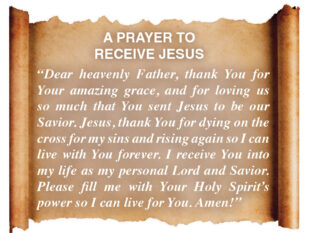
Our Creator—who revealed His written Word to us—wants us to know that His divine Son is the predicted Messiah. Out of love for all people, Jesus Christ conquered sin and death on the cross so we could live in heaven forever. Even now, with open arms of love, Jesus welcomes everyone to receive His free gift of salvation. “For God so loved the world that He gave His only begotten Son, that whoever believes in Him should not perish but have everlasting life” (John 3:16).
__________________________________________
REFERENCES: 12 Tim. 3:16; Heb. 4:12; 1 Pet. 1:23. Dr. Norman Geisler, Systematic Theology (Introduction), Vol. I (Bethany House, 2011), 561. See also Josh and Sean McDowell, Evidence That Demands a Verdict (Updated), (Thomas Nelson, 2017), Chapters 1 to 5. 2John 3:16; 1 Cor. 15:1–4; Matt. 27:33–54. 3-4Dr. Normal Geisler, “How Do We Know the Bible Is the Word of God?,” https://normangeisler.com/how-do-we-know-the-bible-is-the-word-of-god/. 52 Pet. 1:20–21. See also Geisler, footnote 3. 6Matt. 4:4; 22:29; John 10:35; 17:17. 72 Tim. 3:16. 8Heb. 10:7. See J. Vernon McGee, JESUS: Centerpiece of Scripture (Thomas Nelson, Inc., 1995). See also Chuck Smith, Wisdom for Today, August 12 devotional (The Word For Today, 2007). 9Heb. 10:7; see also Luke 24:44.10Dr. W. A. Criswell, “The Scarlet Thread of Redemption,” The Open Bible (NKJV) (Thomas Nelson., Inc., 1997), 1353.11Josh McDowell, The New Evidence That Demands a Verdict, Chapter 8 (Thomas Nelson, 1999). 12Peter W. Stoner and Robert Newman, Science Speaks: Scientific Proof of the Accuracy of Prophecy and the Bible (Moody Press, 1976), 100–110. See also David R. Reagan’s article, https://christinprophecy.org/articles/applying-the-science-of-probability-to-the-scriptures/. 13-14Stoner and Newman, 106–112. See also Josh and Sean McDowell (quoting Stoner), 230–231. 15Isa. 42:8–9; 46:9–11; 48:3–5. 16Josh and Sean McDowell, 52–53. 17Bruce Metzger, The Text of the New Testament (Oxford Univ. Press, 1992), 86. See also Josh and Sean McDowell, 64. 18Institute for New Testament Textual Research (INTTR) Munster, Germany, as referenced in Josh and Sean McDowell, 47–48. 19F. F. Bruce, The New Testament Documents: Are They Reliable? (IVP and Eerdmans, 1998), 26. 20GotQestions.org, “What Is the Septuagint?” https://www.gotquestions.org/septuagint.html. 21Norman Geisler and Ronald Brooks, When Skeptics Ask (SP Publications, 1990), 157–159. 22Facsimile Editions, The Dead Sea Scrolls, The Great Isaiah Scroll, 1Qlsa, https://facsimile-editions.com/facsimiles/. 23Norman Geisler and William Nix, A General Introduction to the Bible (Moody Press,1986), 380.
(To view or order this full-color apologetics tract, click over to our “TWT” webstore:)
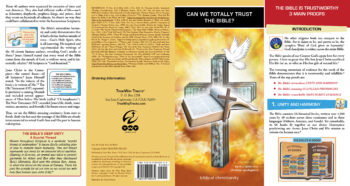
(8 panels, gatefold, Sides A and Side B)